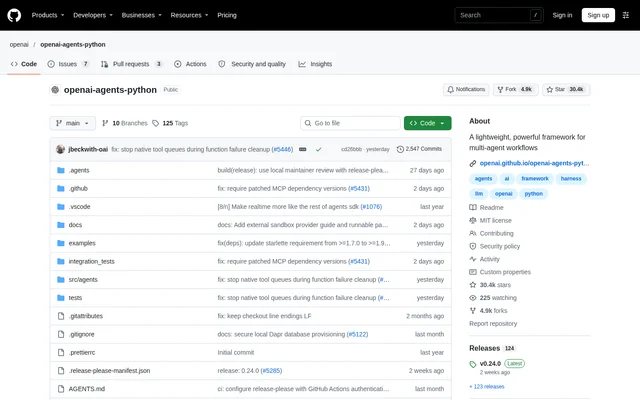
What is OpenAI Agents SDK?
OpenAI Agents SDK is an open-source Python framework for building workflows involving multiple language-model agents. OpenAI Agents SDK supports the OpenAI Responses and Chat Completions APIs as well as other language models. The framework is intended for developers who need agents configured with instructions, tools, guardrails, and delegation mechanisms rather than a standalone chat interface.
OpenAI Agents SDK is published in the openai-agents-python repository under the MIT license. The repository includes documentation, examples, integration tests, and a development guide. The page also points developers looking for a JavaScript or TypeScript implementation to a separate Agents SDK JS/TS project.
What OpenAI Agents SDK can do
OpenAI Agents SDK combines agent coordination with tools, validation, conversation history, and workflow inspection. Agents can delegate specific tasks to other agents or expose agents as tools. The framework also includes mechanisms for involving humans across runs, while tracing helps developers view, debug, and optimize agent workflows.
- OpenAI Agents SDK supports function tools, MCP tools, and hosted tools.
- OpenAI Agents SDK applies configurable safety checks to inputs and outputs.
- OpenAI Agents SDK manages conversation history automatically through sessions.
- OpenAI Agents SDK tracks agent runs with built-in tracing.
- OpenAI Agents SDK provides sandbox agents that inspect files, run commands, and apply patches.
- OpenAI Agents SDK supports realtime voice and multimodal experiences over WebSocket.
- OpenAI Agents SDK combines speech-to-text, agent workflows, and text-to-speech in voice pipelines.
How OpenAI Agents SDK works
OpenAI Agents SDK is installed into a Python environment using pip or uv. The getting-started instructions require Python 3.10 or newer and tell developers to set the OPENAI_API_KEY environment variable before running the examples. Optional package groups add voice capabilities and Redis session support.
OpenAI Agents SDK provides different execution paths for different workloads. A text Agent handles workflows without a persistent realtime connection or sandbox workspace. SandboxAgent preserves workspace state for longer tasks, RealtimeAgent supports server-side WebSocket experiences, and VoicePipeline processes audio through an agent workflow before streaming generated speech.
Who OpenAI Agents SDK is for
OpenAI Agents SDK is for developers building agent applications in Python, including applications that need specialized task delegation, persistent workspaces, or spoken interaction. The repository examples illustrate both text-based agents and audio workflows. Developers can also use the included tracing and guardrails when inspecting agent behavior and validating workflow inputs or outputs.
- OpenAI Agents SDK supports applications that delegate specialized tasks between agents.
- OpenAI Agents SDK supports workspace assistants that inspect repositories and summarize files.
- OpenAI Agents SDK supports voice assistants that process audio and stream generated speech.
OpenAI Agents SDK pricing and access
OpenAI Agents SDK is available as an open-source framework under the MIT license, with package installation through pip or uv. The supplied repository text does not list SDK subscription plans or model API prices. The accompanying GitHub pricing material describes GitHub services rather than an OpenAI Agents SDK pricing plan.
OpenAI Agents SDK strengths and limitations
OpenAI Agents SDK brings agent delegation, session management, validation, and tracing into the same framework. Provider-agnostic model support and separate text, sandbox, realtime, and voice workflows give developers several implementation paths. OpenAI Agents SDK remains a code-based framework requiring environment setup, with additional dependencies and sandbox choices depending on the intended workflow.
- OpenAI Agents SDK requires Python 3.10 or newer.
- OpenAI Agents SDK requires optional package groups for voice and Redis session support.
- OpenAI Agents SDK uses UnixLocalSandboxClient on macOS and Linux; Windows requires DockerSandboxClient or a hosted sandbox client.
- OpenAI Agents SDK accepts repository pull requests only from collaborators.
OpenAI Agents SDK FAQ
What is OpenAI Agents SDK?
OpenAI Agents SDK is an open-source Python framework for building multi-agent workflows. OpenAI Agents SDK supports agents configured with instructions, tools, guardrails, and handoffs, alongside sessions, tracing, sandbox tasks, realtime experiences, and voice pipelines.
Is OpenAI Agents SDK free?
OpenAI Agents SDK is available as an open-source framework under the MIT license. The repository does not list SDK subscription plans or model API prices, so the source does not establish the total cost of running applications built with OpenAI Agents SDK.
Which models and APIs does OpenAI Agents SDK support?
OpenAI Agents SDK is provider-agnostic and supports the OpenAI Responses and Chat Completions APIs, as well as 100+ other language models. OpenAI Agents SDK also lists any-llm and LiteLLM among its optional dependencies.
How do you install OpenAI Agents SDK?
OpenAI Agents SDK can be installed with pip install openai-agents or added through uv. OpenAI Agents SDK requires Python 3.10 or newer, offers optional voice and Redis package groups, and instructs developers to set OPENAI_API_KEY before running the supplied examples.
Can OpenAI Agents SDK build voice agents?
OpenAI Agents SDK supports realtime voice and multimodal experiences through RealtimeAgent over WebSocket. OpenAI Agents SDK also provides VoicePipeline to combine speech-to-text, an agent workflow, and streamed text-to-speech output, with voice support installed through an optional package group.
Does OpenAI Agents SDK support MCP and agent handoffs?
OpenAI Agents SDK supports MCP tools, function tools, and hosted tools. OpenAI Agents SDK also supports agents as tools and handoffs for delegating specific tasks to other agents, plus built-in mechanisms for involving humans across agent runs.
From the community
No reviews yet
Be the first to review this tool. What you write helps the next person choose.