What is ClaudePrism?
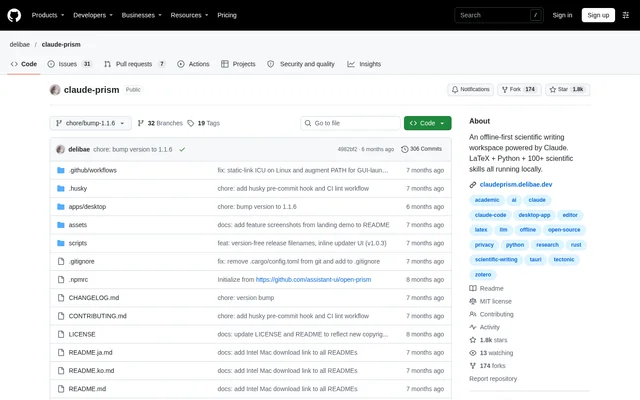
ClaudePrism is an open-source desktop workspace for scientific writing that brings together LaTeX, Python, and Claude assistance. ClaudePrism serves researchers and academic writers who need document editing, scientific computation, and PDF review within the same application. The project uses Tauri and Rust and began from Open Prism by assistant-ui.
ClaudePrism follows a local-first approach: documents remain on the user's disk, editing happens locally, and LaTeX compilation runs through an embedded engine. That local workflow does not make Claude inference offline. When AI features are used, prompts and file contents that Claude reads are sent to Anthropic's API.
What ClaudePrism can do
ClaudePrism combines document preparation, scientific analysis, reference management, and AI-assisted editing. The editor includes LaTeX and BibTeX syntax highlighting, real-time error linting, regular-expression search and replacement, and multi-file projects with automatic saving. Scientific skills add domain-specific prompts and tool configurations, covering areas such as bioinformatics, cheminformatics, machine learning, clinical research, and scientific communication.
- ClaudePrism compiles LaTeX locally using embedded Tectonic.
- ClaudePrism creates project-level Python virtual environments through uv.
- ClaudePrism offers 100+ scientific skills for installation.
- ClaudePrism renders PDF previews with MuPDF and SyncTeX navigation.
- ClaudePrism connects to Zotero for bibliography management and citation insertion.
- ClaudePrism records saves as local Git snapshots.
How ClaudePrism works
ClaudePrism starts projects through a template gallery and project wizard. Users choose a document type, name the project, and optionally describe the writing task so initial content can be generated with AI. Reference PDFs, bibliography files, and images can be added by drag and drop. Claude chat is available directly inside the editor.
ClaudePrism lets users select Sonnet, Opus, or Haiku and adjust reasoning effort. Proposed edits appear in a dedicated panel with visual diffs, where individual chunks can be accepted or rejected. PDF capture attaches a selected region to the chat composer for questions about equations, figures, tables, or reviewer comments.
Who ClaudePrism is for
ClaudePrism is suited to scientific and academic work that combines structured documents, references, and computation. The available templates cover papers, theses, presentations, posters, and letters. The integrated Python environment supports generating plots, running analysis scripts, and processing data without leaving the editor, while installed scientific skills supply domain-specific context for Claude.
- ClaudePrism supports researchers drafting papers and theses.
- ClaudePrism supports scientific users generating plots and processing data.
- ClaudePrism supports writers managing citations and reviewing PDF content.
ClaudePrism licensing and access
ClaudePrism is distributed as an open-source project under the MIT license, and the installation instructions direct users to download the latest build from GitHub Releases. The repository also provides contribution guidelines for development setup and testing. The product text does not specify an AI subscription price or API usage charges.
ClaudePrism strengths and limitations
ClaudePrism combines local document storage, embedded LaTeX compilation, scientific Python tooling, and reviewable AI changes. Git-based snapshots provide checkpoints, diffs, and restoration of earlier versions. The main boundary is between local writing tools and remote AI inference: document storage and compilation remain local, but Claude assistance sends relevant content to Anthropic's API.
- ClaudePrism requires package downloads on first use before cached compilation works fully offline.
- ClaudePrism sends AI prompts and file contents read by Claude to Anthropic's API.
- ClaudePrism requires scientific skills to be installed globally or per project.
ClaudePrism FAQ
What is ClaudePrism?
ClaudePrism is an open-source, offline-first desktop workspace for scientific writing. ClaudePrism combines LaTeX editing, local compilation, scientific Python environments, PDF preview, reference management, and Claude assistance for research and academic documents.
Is ClaudePrism free?
ClaudePrism is available as an open-source project under the MIT license, with desktop builds downloadable from GitHub Releases. The source does not state pricing for Claude access or Anthropic API usage.
Does ClaudePrism work offline?
ClaudePrism supports local document storage, editing, and offline LaTeX compilation after Tectonic packages have been downloaded and cached. ClaudePrism AI features are not fully offline: prompts and file contents read by Claude are sent to Anthropic's API for inference.
Can ClaudePrism run Python for scientific analysis?
ClaudePrism integrates uv and project-level virtual environments for scientific Python work. Claude Code automatically uses the project's virtual environment when running Python, allowing users to generate plots, run analysis scripts, and process data inside the editor.
Does ClaudePrism integrate with Zotero?
ClaudePrism includes OAuth-based Zotero integration for bibliography management and citation insertion. ClaudePrism also supports BibTeX syntax highlighting and lets users drag bibliography files, PDFs, and images into a writing project.
How does ClaudePrism handle AI edits and version history?
ClaudePrism creates a snapshot in a local Git repository whenever a document is saved. ClaudePrism displays proposed AI edits with visual diffs, supports accepting or rejecting individual chunks, and lets users label checkpoints, compare snapshots, and restore previous versions.
From the community
No reviews yet
Be the first to review this tool. What you write helps the next person choose.